Loading...

Three eco-conscious audiences for Earth Day

Published: April 18, 2023 by Experian Marketing Services

As Earth Day approaches, it’s the perfect opportunity for marketers to explore innovative ways to engage with eco-conscious customers. With a strong and growing interest in sustainable business practices worldwide, green audiences are becoming increasingly influential. In addition to being good for the planet, engaging these customers is great for any brand or organization striving to become more eco-friendly and socially responsible. By taking advantage of this timely event and using appropriate tools, you can create personalized campaigns that will both promote your brand and increase customer loyalty.

Eco-conscious audiences

In this blog post, we’ll cover three eco-conscious audiences to target this Earth Day:

  1. Solar energy
  2. GreenAwareTM
  3. Electric vehicles

Solar energy

Our first eco-conscious audience is Solar energy. Consumers in this audience show an inclination toward harnessing the power of the sun as a clean, renewable energy source. Our audience data can provide valuable insights into the Solar energy consumer base, including their age, education level, occupation, household income, and communication preferences. Let’s explore these metrics to better understand how to reach this group effectively.

Age and living situation

Consumers in our Solar energy audience are more likely to live in a home with two or more adults and are between the ages of 45-74.
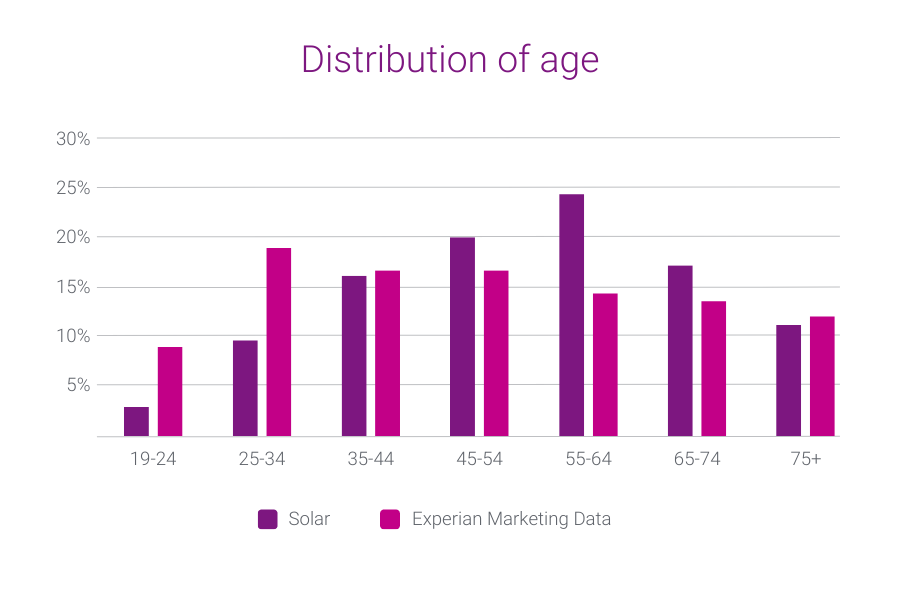
consumers in the eco-conscious solar energy audience are more likely to be between ages 45-74

Education level and occupation

Consumers in our Solar energy audience are more likely to have graduated from college or graduate school and work in management-level occupations.
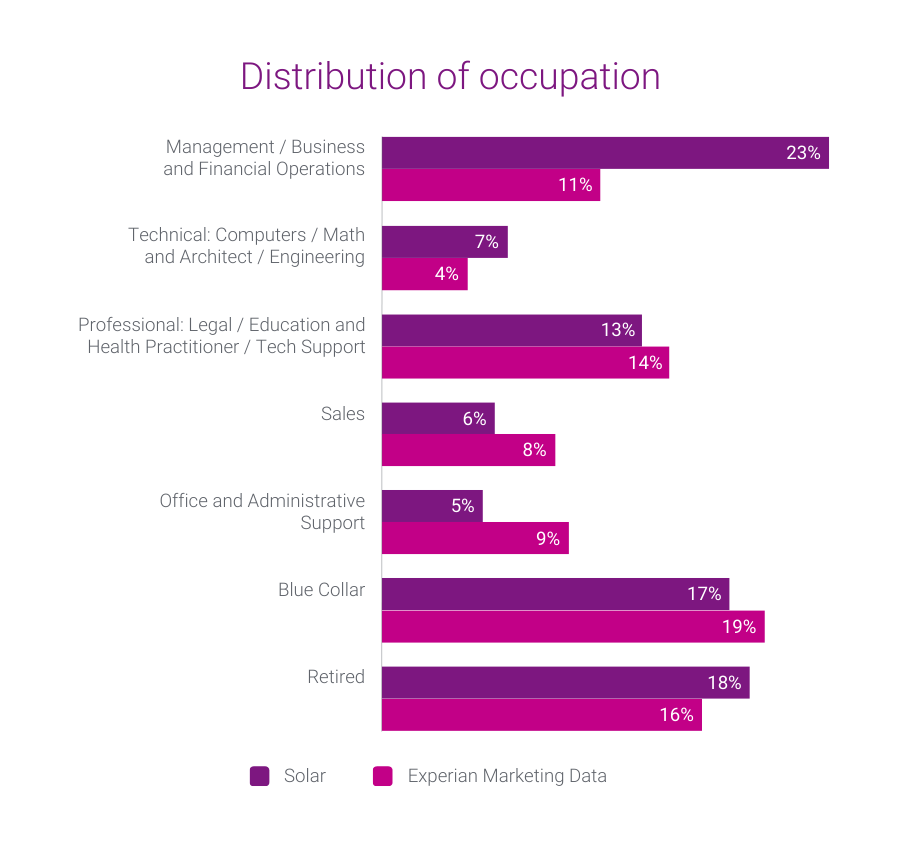
consumers in the eco-conscious solar energy audience are more likely to work in management-level occupations

Household income

Consumers in our Solar energy audience have household incomes of more than $75,000 and their homes are valued at over $550,000.
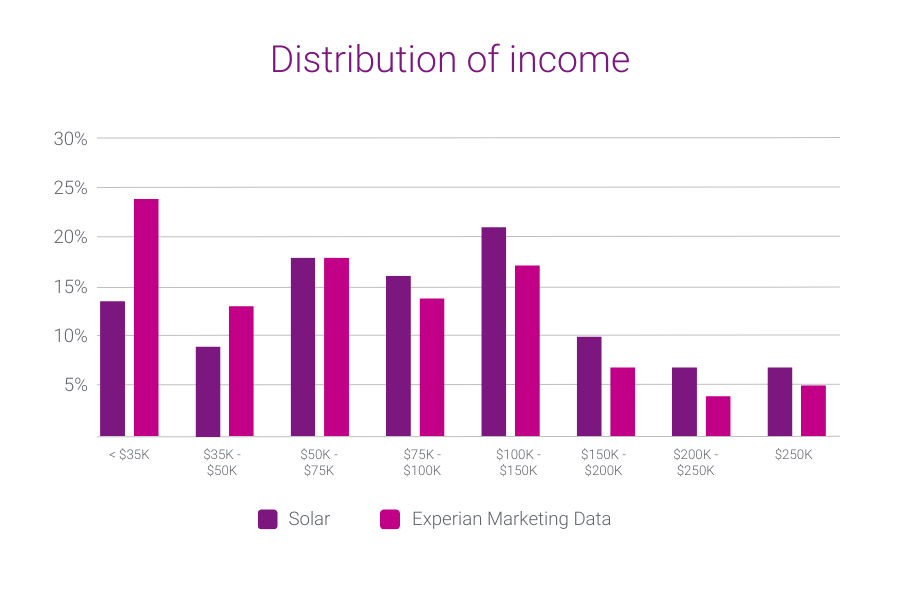
consumers in the eco-conscious solar energy audience have household incomes of more than $75,000

Preferred engagement channels

Consumers in our Solar energy audience are most receptive to ads served through digital channels like digital newspapers and email.
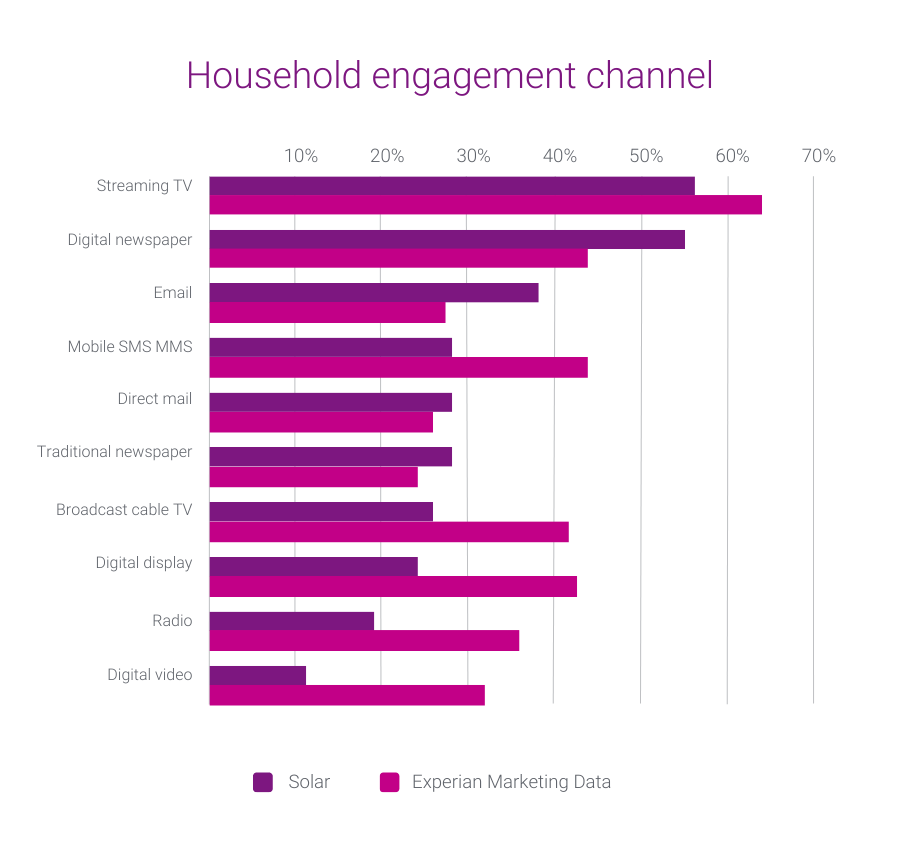
consumers in the eco-conscious solar energy audience are most receptive to ads through streaming tv and digital newspaper

Solar energy audience pairings

Consumers in our Solar energy audience also belong to three of our Mosaic® USA groups:

  1. Power Elite
  2. Flourishing Families
  3. Booming with Confidence

Our consumer segmentation portal of 126 million households and 650 lifestyle and interest attributes empowers marketers like you to precisely target your ideal audience and communicate with them on a personal level. Mosaic’s data segments the U.S. into 19 overarching groups and 71 underlying types, giving you the insights needed to anticipate the behavior, attitudes, and preferences of your most profitable customers and communicate with them on their preferred channels, with messaging that resonates.

GreenAware

Our second eco-conscious audience is GreenAware.

GreenAware segments the 126 million U.S. households within Experian Marketing Data into four distinct groups. Each group differs in their attitudes and behaviors toward purchasing products that are environmentally safe and working with companies that are eco-conscious. We created these groups using an enhanced application of traditional statistical clustering techniques based on environmentally relevant measurements in Simmons’ National Consumer Study.

Based on the distinctive mindset of consumers toward the environment, you can learn how environmental concerns fit into their lives through four major consumer segments:

  1. Eco-Friendly Enthusiasts
  2. Sustainable Spectators
  3. Passive Greenies
  4. Eco Critics

Let’s dive deeper into each group to understand their unique perspective on the environment and how this impacts their attitudes and behaviors.

Eco-Friendly Enthusiasts

This eco-conscious segment prioritizes a green lifestyle and takes pride in avoiding products that harm the planet. With traditional and liberal values, they embrace optimism and prioritize family. With their children out of the house, they take the time for some well-deserved rejuvenation and are committed to a healthy lifestyle. Some members of this group are transitioning into retirement and welcoming a new chapter in their life.

  • Mature adults and retirees
  • College graduate or more
  • Above average income
  • May be married or single
  • Typically own their homes

Sustainable Spectators

This segment aspires to be more sustainable, but they struggle with translating their green ideas into action. They have a soft spot for a cozy home. While their love for interior design and taking care of their own space is evident, they’re always looking for new experiences and opportunities to learn. Staying healthy and active is a top priority for this group, so it’s no surprise that they’re always looking for ways to stay fit and feel their best.

  • Established and mid-life adults
  • College graduate or more
  • High income
  • Typically married
  • Likely to own their homes

Passive Greenies

This is the largest and one of the most youthful groups. Known for their love of exploration and self-discovery, they may not have fully embraced eco-conscious behaviors yet, but they are eager to stay current with the latest technology and trends. With their incredible ability to multitask, they’re always on-the-go, and constantly seek the next best thing.

  • Mainly young adults and diverse
  • Education ranges from high school through some college
  • Below average income
  • More likely to be single or divorced
  • Typically rent

Eco Critics

This group is not likely to be eco-conscious and may have negative attitudes about the environment. They are confident, driven, and focused on their personal growth. They crave instant gratification, seeking out quick and easy solutions to their everyday decisions. They place a high value on entertainment, their social life, and carefully curate their image.

  • Young and established adults
  • Education ranges from high school through post-graduate studies
  • High income
  • Married or single
  • Typically own their homes

Let’s take a look at how the GreenAware segments stack up against each other in terms of age, household income, education level, and media preference. How do they compare? Let’s find out.

Age

Consumers in the Eco-Friendly Enthusiasts segment are the oldest of the four GreenAware segments – about half of the consumers are 65 or older. Eco Critics are the youngest segment, with over half of consumers in this group between ages 25-44.
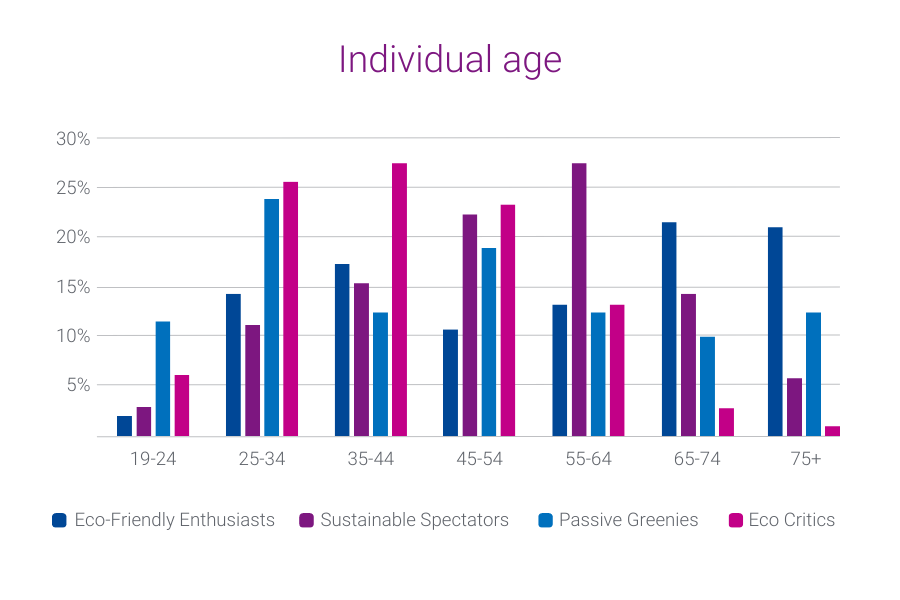
consumers in the "eco-friendly enthusiasts" audience are the oldest of the eco-conscious audience segments

Household income

Sustainable Spectators and Eco Critics are the wealthiest GreenAware segments. The average household income of consumers in these segments is above $100,000. Passive Greenies have the lowest household income, with a majority below $50,000.
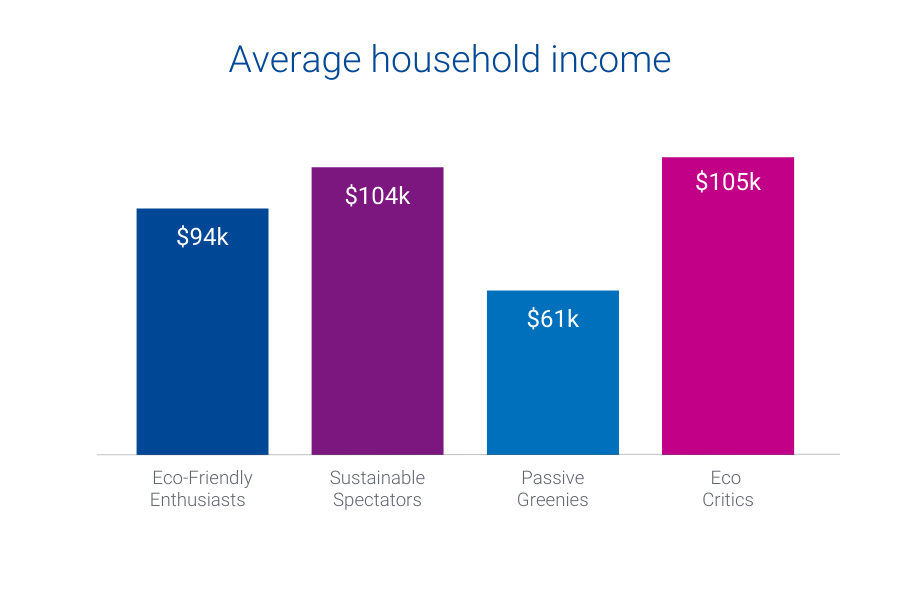
sustainable spectators and eco critic consumers are the wealthiest of the eco-conscious audiences

Education level and occupation

Passive Greenies are more likely to work Blue Collar jobs and have the lowest level of education. As the wealthiest segments, Sustainable Spectators and Eco Critics have the highest levels of college degrees and work in management, business, and financial operations. Eco-Friendly Enthusiasts are the most likely to be retired and out of the workforce.
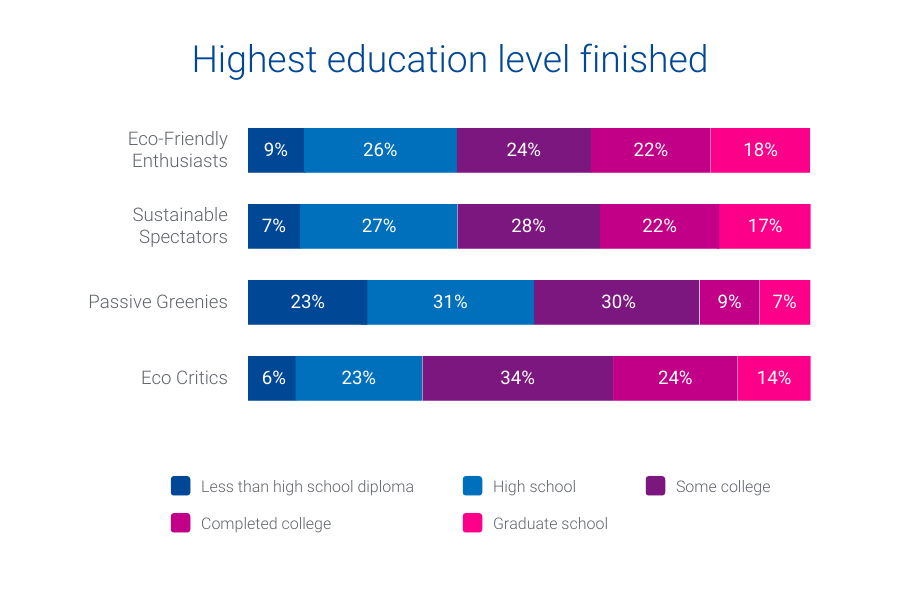
graph of eco-conscious audiences and the highest education level they have finished

Preferred engagement channels

  • Streaming TV is the preferred engagement channel for all GreenAware segments.
  • Eco-Friendly Enthusiasts prefer digital channels like digital newspapers, mobile SMS, and email. They also engage with traditional channels like direct mail and newspaper.
  • Passive Greenies have a high preference for digital display, mobile SMS, digital video, broadcast cable TV, and radio.
  • Eco Critics have a high preference for digital channels like digital newspapers, mobile SMS, and digital display.
  • Sustainable Spectators strongly prefer digital newspapers. They don’t show as strong of a preference for mobile SMS and digital display as Eco Critics and Passive Greenies.
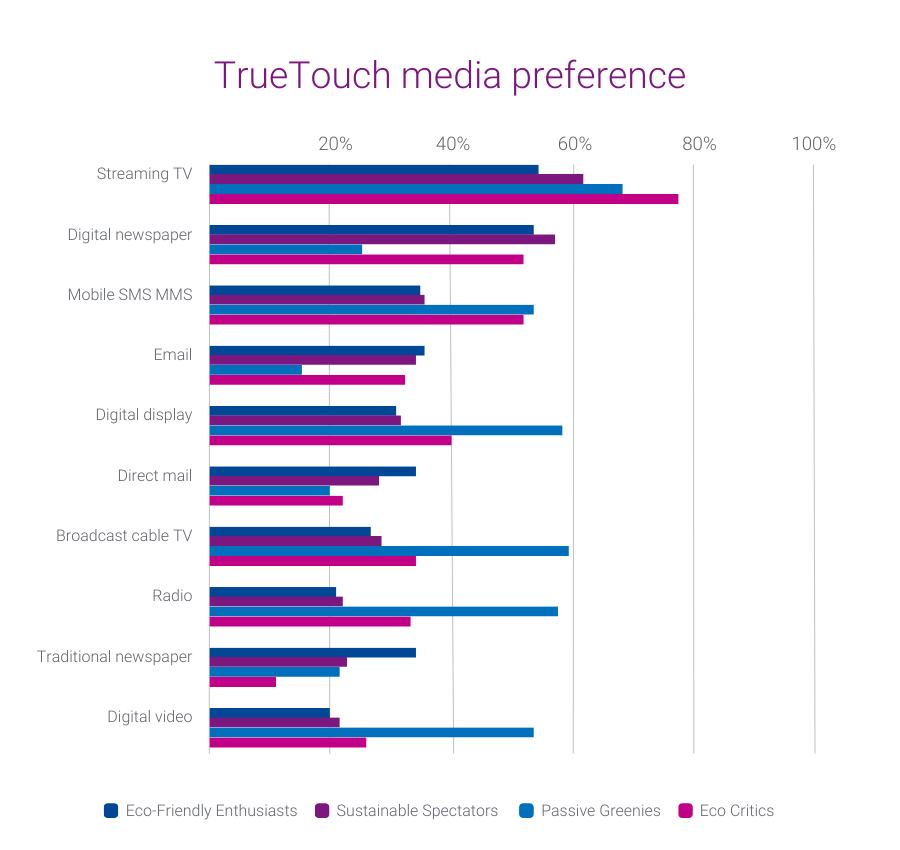
graph of the eco-conscious audiences' preferred engagement channels

GreenAware audience pairings

Six of our Mosaic groups have at least one GreenAware segment with 10% or more of the population. For more precise targeting, below are suggested Mosaic audiences you can pair with each GreenAware segment:

Eco-Friendly EnthusiastsSustainable SpectatorsPassive GreeniesEco Critics
Booming with ConfidencePower EliteSingles and StartersPower Elite
Autumn YearsBooming with ConfidenceGolden Year GuardiansSuburban Style
Golden Year GuardiansSingles and Starters

Electric vehicles

Our third eco-conscious audience is electric vehicles.

Electric vehicles (EVs) are having a major moment in the automotive industry. This is no surprise given that new EV models are being released and an increasing number of charging stations are popping up around the country. As EVs become more prominent, it’s essential to stay up to date on relevant trends to make informed decisions about what lies ahead.

The demand for electric vehicles (EVs) is on the rise

Consumers are embracing the EV revolution, showing their desire for a cleaner, greener future. Automotive marketers are increasingly looking to reach in-market EV shoppers and current alternative fuel vehicle owners due to the growing availability of electric vehicles, improved infrastructure, and rising popularity. In 2022, EVs charged up the market and accounted for a remarkable 6% of new retail registrations.

While Tesla continues to dominate the EV market, Ford, Chevrolet, and Hyundai are starting to compete, each holding more than 3% of the market share of new retail EV registrations.
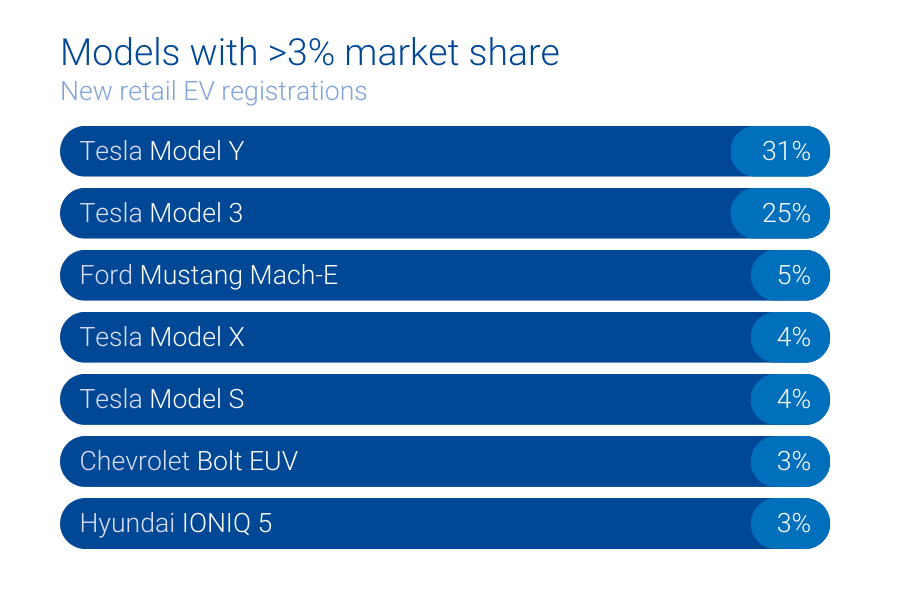
graph showing the demand for electric vehicles by model

Geography

Where are we seeing the most new retail EV registrations? The top designated market areas (DMAs) for new retail EV registrations are mostly located in heavily populated, coastal cities like Los Angeles, CA and New York, NY.
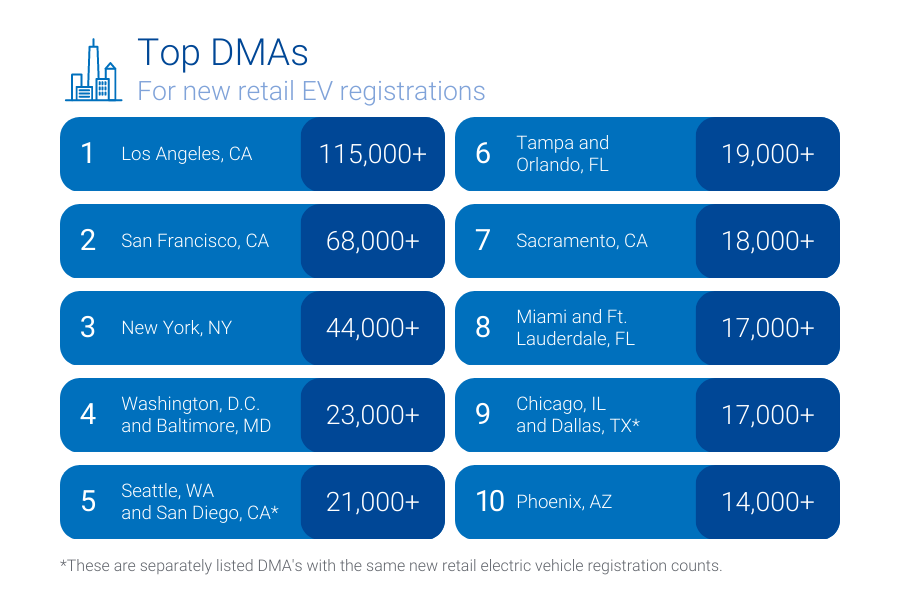
graphic showing the top designated market areas for new retail EV registrations

The fastest growing DMAs, however, are in smaller cities like Tucson, AZ and Oklahoma City, OK.

Generational demographics

Gen X and Millennials make up the largest percentage of new retail EV buyers at 37.5% and 34.4%. Gen Z and the Silent generation represent the smallest shares at 5% and 2.1%. Boomers hover between Gen X and Millennials’ share and account for 20.6% of new EV retail purchases.

EV audience pairings

Our top five Mosaic groups for new EV buyers include:

  1. American Royalty
  2. Cosmopolitan Achievers
  3. Philanthropic Sophisticates
  4. Couples with Clout
  5. Fast Track Couples

How to target consumers in-market for electric vehicles

We offer 70+ audiences that are focused on likely buyers and owners of EV and plug-in hybrid (PHEV) vehicles. We also offer a subset of 28 audiences focused on individual EV/PHEV vehicle models.

Below is how you can find a few of these audiences on-the-shelf of most trusted advertising platforms:

  • Autos, Cars, and Trucks > In Market-Fuel Type > Electric
  • Autos, Cars, and Trucks > In Market-Fuel Type > Used Electric
  • Autos, Cars, and Trucks > In-Market Make and Models > Tesla
  • Autos, Cars, and Trucks > In-Market Make and Models > Chevrolet Bolt EV

We can help you reach eco-conscious consumers

Earth Day is a great opportunity to get creative with your marketing efforts with our three eco-conscious audiences: Solar energy, GreenAware, and electric vehicles. To find out how you can add eco-conscious audiences to your marketing plan, contact us.

Get in touch

This site is protected by reCAPTCHA and the Google Privacy Policy and Terms of Service apply.


Latest posts

Loading…
One month at Experian. A stronger conviction in identity.

I’ve officially been at Experian Marketing Services for one month. That’s long enough to get past the onboarding checklists, meet an incredible number of people, and start connecting the dots between what I believed from the outside and what I now see clearly from the inside. What’s surprised me most is not the scale of Experian's assets. Everyone knows Experian operates at massive scale. It’s the uniqueness of how those assets come together. Identity. Activation. Curation. Optimization. Measurement. And a culture that understands the responsibility that comes with being the identity and data backbone for the AdTech ecosystem. There’s real energy here around not just what’s possible, but how to do it the right way. Very early on, this felt like the right move. The people confirmed it immediately. The leadership team reinforced it just as quickly. There’s alignment around how we go to market, how we think about identity, and how seriously we take client trust. That matters, especially in a moment when marketers are being asked to do more with less, prove everything, and still protect the consumer at every turn. The reality marketers are facing right now I’ve spent my career working with brands and agencies navigating change. What’s different right now is the level of fragmentation. Signals are everywhere. They’re coming from transactions, media exposure, location, content consumption, commerce, and increasingly from AI-driven interactions that don’t follow traditional linear paths. The challenge is no longer access to data. It’s coherence. If I’m a marketer today, my core question is simple: How do I tie a durable identity structure to constantly evolving consumer signals, and feed that intelligence into the right places at the right time? Especially as I start interacting with AI buying agents that will make decisions on my behalf. If the signals those systems receive are noisy, incomplete, or misaligned with my brand, I lose control fast. Identity has to be the foundation That’s where identity stops being a background capability and becomes foundational. Without a strong, continuously refreshed identity framework, everything downstream breaks. Planning becomes guesswork. Activation becomes inefficient. Measurement becomes misleading. I see too many brands treating identity as a one-time project. Build a graph. Do some householding. Declare victory. But people change. Households change. Signals multiply. Identity has to evolve just as fast. One of the biggest misconceptions I walked into was how narrowly Experian is often viewed. Many marketers still think of us as a place to buy attributes. Full stop. What I see now is a connected system that supports the full marketing lifecycle: Audience creation Activation Curation Optimization Measurement All grounded in identity and executed in a way that’s measurable and privacy-forward. Audigent + Experian’s data marketplace. This is where things click. This becomes even more powerful when you layer in Audigent. Audigent was foundational in defining curation, the idea that it’s not just about having data or inventory, but about intentionally pairing the right audience signals with the right supply to drive outcomes. When you combine Audigent’s curation expertise with Experian’s identity, data, and marketplace capabilities, something meaningful happens. That same philosophy extends directly into our data marketplace. It’s not just about accessing unique data sets. It’s about safely combining Experian data with partner data, or even multiple partner data sets together, to create audiences that simply don’t exist anywhere else. Then tying those audiences to real-world exposure and conversion across online and offline environments. This matters across industries, but especially in two places: Regulated verticals like healthcare and financial services, where accuracy and privacy are non-negotiable. Industries sitting on valuable first-party data like retail, travel, and automotive. No single company has all the signals they need. The opportunity is in collaboration. Partnering data in a trusted environment to create better outcomes and, in many cases, entirely new revenue streams. Looking ahead As AI continues to reshape how media is planned and bought, signals will become the currency. Not just any signals. The right ones. Curated, contextual, and connected to identity in a way that reflects real consumer behavior. Marketers who win will be the ones who control that signal flow, rather than reacting to it. After one month, what excites me most is that Experian is built for this moment. Years of investment in identity. A data marketplace designed for collaboration. And teams who understand that our job is not just to help marketers reach people, but to help them do it responsibly, efficiently, and in a way that actually drives outcomes. We’re just getting started. About the author Kevin Dunn Chief Revenue Officer, Experian Kevin Dunn joins Experian Marketing Services with more than 20 years of leadership experience across marketing and advertising technology, most recently serving as Senior Vice President of Brands and Agencies at LiveRamp. In that role, he led growth across retail, CPG, travel, hospitality, financial services, and healthcare, overseeing new business, account expansion, and channel partnerships. Kevin is known for building cohesive, accountable teams and leading with optimism, clarity, and a strong sense of shared purpose. His leadership philosophy centers on empowering people, driving positive outcomes for clients and fostering a culture where teams can grow, take smart risks, and succeed together. Latest posts

Jan 30,2026 by Kevin Dunn, Chief Revenue Officer

What happens when first-party, third-party, contextual, and geographic data work together

How should CMOs think about data as part of their audience strategy? The best digital marketers possess excellent storytelling capabilities—and they fuel the plot with data. When you think about it, your audience strategy is the whole story, and the type of data you use helps create each chapter. Just as any good book incorporates numerous literary devices, you must use more than one type of data to develop a dynamic, relevant, and timely narrative that captures your target users’ attention. In 2026, marketers should prioritize and invest in data and targeting strategies beyond just first-party to drive growth, improve efficiency, and strengthen customer relationships. Our 2026 Digital trends and predictions report is available now and reveals five trends that will define 2026. From curation becoming the standard in programmatic to AI moving from hype to implementation, each trend reflects a shift toward more connected, data-driven marketing. The interplay between them will define how marketers will lead in 2026. Download Why is first-party data not sufficient on its own? First-party data provides a strong foundation for targeting and measurement. It reflects information consumers have shared directly through brand interactions. That makes it reliable and central to audience strategy. That foundation alone does not tell the full story. First-party data defines known customers, but limits reach and frequency. Growth depends on expanding beyond existing relationships. Think of first-party data as a way to create an outline, not the whole story, about your target audiences—the main characters in your marketing. To flesh out the entire narrative about them, you must source, connect, and activate additional data. The ability to unify different data sources with accuracy, scale, and privacy at the forefront sits at the core of Experian’s business. We unify household, individual, device, demographic, behavioral, and first-party signals, along with contextual and geographic data points, to build a reliable view of consumers, even when specific signals are missing. This clarity helps you personalize, target, activate, and measure with confidence. By layering third-party data, contextual data, and geolocation data onto your first-party data foundation, your advertising strategies become stronger than if you used any of these sources as standalone solutions. How do different types of third-party data add depth to audience profiles? Third-party data expands understanding beyond known customers. If first-party data is the outline, third-party data helps with “character development”—a.k.a., adding detail to your audience profiles. Good third-party marketing data complements first-party insights with demographic, behavioral, and transactional context, providing the missing puzzle pieces to complete the full customer profile. Filling in gaps in customer understanding helps you identify, reach, and engage current and new customers more effectively. Third-party data allows brands to build loyalty with consumers by speaking to their interests and intent behind purchases. Third-party data opens up new targeting tactics for advertisers, such as: Behavioral How people engage with brands or how they use social media Demographic Age, gender, education, income, and religion Health A combination of demographics, behaviors, and health needs Interest Delivering ads based on interests, hobbies, or online activities Location Where people live, work, or spend large amounts of time Psychographics Shared characteristics like attitudes, lifestyles, and interests Purchases Using previous purchase behavior to identify the right audiences In addition to targeting, third-party data also remains critical to AI models, which must train on both structured and unstructured data. At Experian, our AI-powered technology interprets live bidstream data, device activity, content, and timing to optimize in the moment, ensuring campaigns deliver meaningful relevance, not just broader reach. How are contextual and geographic approaches reshaping audience targeting? Contextual and geographic approaches to targeting focus on environment and behavior rather than identifiers. Regulatory scrutiny, stricter and more fragmented compliance standards, and rising consumer expectations are transforming how marketers approach third-party data targeting. Evolving privacy laws and inconsistent identifiers across environments require new approaches that balance performance and privacy. Contextual and geographic targeting help marketers reach relevant audiences while maintaining privacy. What is data-informed contextual targeting? Contextual targeting connects audience attributes to the content environments people choose. It helps determine the setting of your story—where your characters spend their time. Solutions like Experian’s Contextually-Indexed Audiences harness advanced machine learning technology to combine contextual signals (a tried–and-true targeting tactic) with third-party targeting to ensure marketers reach their target audiences on the content they tend to consume, regardless of environment or location. What’s excellent about data-informed contextual targeting is that it moves beyond traditional keyword-based strategies to reach consumers on websites that over-index for visitors with the demographics, behaviors, or interests they are looking to target. What is data-informed geotargeting? Geotargeting uses shared location patterns to support relevance at scale. Geotargeting is another possibility for further developing the scene of your story. People with similar behaviors and interests tend to live in similar areas, which is why so much effort goes into location planning for brick-and-mortar stores. Data-informed geotargeting combines geos with third-party data to make more informed media buys based on common behaviors within a geographic location. We launched our Geo-Indexed audiences, which use advanced indexing technology to identify and reach consumers based on their geographic attributes. These audiences help marketers discover, segment, and craft messaging for consumers without relying on sensitive personal information, enabling them to reach target audiences while maintaining data privacy confidently. What role does AI play in third-party data targeting? AI acts like an automated editor of your book, refining and finding new ways to put valuable third-party audiences and data to work without relying on segments linked to known or disparate identifiers. We’ve used AI and machine learning at Experian for decades to bring identity, insight, and generative intelligence together so brands and agencies can reach the right people, with relevance, respect, and simplicity. Why does a balanced, integrated approach that combines first-party, third-party, contextual, and geo-targeting data matter? The combined effects of integrating third-party, contextual, and geotargeting data (and the marketing tactics it underpins) with first-party data will drive your success. Think of how any good author crafts a story. Regardless of whether it’s fiction or non-fiction, they draw on both first-person experience and external research and sources to develop their plot. No single data source tells the full story. Integration allows marketers to understand audiences more completely and act with confidence. Pooling these inputs together moves you closer to your goal of understanding the whole story about your target customers. In fact, an almost even number of marketers plan to use contextual targeting (41%) and first-party data (40%) as their main targeting strategies, amid privacy laws and the loss of persistent advertisers. Primary data strategyPercent of marketers that plan to use this data strategyContextual targeting41%First-party data40% A brand with strong first-party insights can extend reach by layering in additional signals. For example, a nutrition brand that knows who purchases protein supplements can expand prospecting by combining: First-party signals Customers who purchase protein supplements Contextual signals Engagement with fitness blogs, healthy recipe content, or workout apps Geographic signals Consumers located in the Greater Philadelphia area By connecting these inputs, the brand can identify new health-conscious audiences with similar interests and behaviors. This approach supports privacy-safe targeting while improving engagement and performance. How can marketers build an integrated data strategy in 2026? An integrated data strategy reduces friction and supports scale. The right data partner offers a unified solution that helps unify data, activate audiences, and adapt as the ecosystem evolves. Here’s how: Organize data Create a clean, usable data foundation by eliminating fragmented silos. Experian’s solutions unify disparate data, enabling identity resolution and a single customer view. Create a complete profile Experian links a persistent offline core of personally identifiable information (PII) data with fresh digital signals, giving you a high-fidelity view of consumers to decorate with marketing data. This allows for improved customer understanding and personalized marketing that competitors struggle to replicate. Build addressable audience segments Create audiences using a mixture of signals, including first-party data, third-party behavioral, interest, and demographic data, as well as contextual signals. If you partner with Experian, you can use audiences built on our identity graph to guarantee accuracy, scale, and maximum addressability. Drive innovation Look for partners and platforms that prioritize innovation in finding new ways to reach target audiences across the ecosystem. You don’t want a vendor or a system that can’t keep pace and adapt with our rapidly evolving industry. Marketers who want to create and activate campaigns more efficiently and effectively in 2026 need an integrated approach that combines first-party, third-party, contextual, and geotargeting data. Streamlining data integration and activation positions brands and agencies for sustainable growth and stronger consumer relationships in a privacy-conscious marketplace. Build your next chapter on a connected data foundation As audience strategies evolve, connection and interoperability matter more than ever. Connect with our team to learn how Experian helps marketers unify data, identity, and activation across channels. About the author Scott Kozub VP, Product Management, Experian Scott Kozub is the Vice President of the Product Management team at Experian Marketing Services working across the entire product portfolio. He has over 20 years of product experience in the marketing and advertising space.  He’s been with a few startups and spent many years at FICO and Oracle Data Cloud heavily focused on loyalty marketing and advertising technology. FAQs How should CMOs think about data as part of their 2026 audience strategy? In 2026, CMOs should prioritize and invest in data and targeting strategies that combine first-party, third-party, contextual, and geographic data to drive growth, improve efficiency, and strengthen customer relationships.  Why is first-party data not sufficient on its own?  First-party data is not sufficient on its own because first-party data defines known customers but limits reach and frequency. Growth depends on expanding beyond existing relationships. The ability to unify different data sources with accuracy, scale, and privacy at the forefront sits at the core of Experian’s business. We unify household, individual, device, demographic, behavioral, and first-party signals, along with contextual and geographic data points, to build a reliable view of consumers, even when specific signals are missing. This clarity helps you personalize, target, activate, and measure with confidence. How do different types of third-party data add depth to audience profiles? Third-party data expands understanding beyond known customers. Third-party data opens up new targeting tactics for advertisers, such as:  – Location: Where people live, work, or spend large amounts of time- Health: A combination of demographics, behaviors, and health needs- Purchases: Using previous purchase behavior to identify the right audiences – Behavioral: How people engage with brands or how they use social media – Interest: Delivering ads based on interests, hobbies, or online activities- Psychographics: Shared characteristics like attitudes, lifestyles, and interests- Demographic: Age, gender, education, income, and religion  In addition to targeting, third-party data also remains critical to AI models, which must train on both structured and unstructured data. At Experian, our AI-powered technology interprets live bidstream data, device activity, content, and timing to optimize in the moment, ensuring campaigns deliver meaningful relevance, not just broader reach.  What is data-informed contextual targeting? Data-informed contextual targeting connects audience attributes to the content environments people choose. It helps determine the setting of your story—where your characters spend their time. Experian’s Contextually-Indexed Audiences harness advanced machine learning technology to combine contextual signals (a tried–and-true targeting tactic) with third-party targeting to ensure marketers reach their target audiences on the content they tend to consume, regardless of environment or location. What is data-informed geotargeting? Data-informed geotargeting uses shared location patterns to support relevance at scale. Experian launched our Geo-Indexed audiences, which use advanced indexing technology to identify and reach consumers based on their geographic attributes. These audiences help marketers discover, segment, and craft messaging for consumers without relying on sensitive personal information, enabling them to reach target audiences while maintaining data privacy confidently. What role does AI play in third-party data targeting? In third-party data targeting, AI refines and finds new ways to put valuable third-party audiences and data to work without relying on segments linked to known or disparate identifiers. We’ve used AI and machine learning at Experian for decades to bring identity, insight, and generative intelligence together so brands and agencies can reach the right people, with relevance, respect, and simplicity.  Latest posts

Jan 28,2026 by Scott Kozub, VP, Product Management

Why activation and measurement will finally connect in 2026

For years, marketers have worked around a familiar disconnect. Campaigns go live first. Measurement follows later. Insights arrive after audiences are reached, and budgets are committed. That gap has slowed decisions, blurred performance signals, and limited marketers’ ability to respond when it counts. In 2026, that model changes. Activation and measurement no longer operate as separate steps. They function as a single system, where insight informs action as campaigns unfold. Consistency across identity, data, and decision-making sits at the center of this shift, connecting the full campaign lifecycle from planning through outcomes. How is marketing measurement shifting from post-campaign reporting to in-flight intelligence in 2026? Marketing measurement in 2026 is moving from retrospective reporting to real-time input that shapes campaigns while they run. Instead of explaining performance after delivery, measurement now guides creative, audience, and channel decisions as verified outcomes appear. Historically, measurement worked like a post-mortem. Dashboards showed what happened after campaigns ended, or weeks after impressions were delivered. Those insights supported long-term planning but rarely influenced performance in the moment. That dynamic has changed. Today, marketers embed measurement directly into activation. Campaigns adapt while they run. Creative evolves based on engagement quality. Audience strategies adjust as verified outcomes come into view. Channel investments respond to performance signals, not assumptions. Connected ecosystems make this possible. Experian helps marketers plan, activate, and measure within a single framework by linking audiences, identity, and outcomes. When planning and performance live in the same environment, insight becomes actionable in the moment. Why is identity the connective layer between activation and measurement? Identity provides the consistent thread that links planning, activation, and outcomes into a unified system. Without it, marketers rely on proxy signals and disconnected views of performance. For years, fragmented identity frameworks made it difficult to connect media exposure to real-world outcomes. Without a consistent way to recognize audiences across planning, activation, and measurement, marketers relied on proxy metrics and modeled assumptions. That's changing as identity becomes interoperable across the ecosystem. Experian’s Digital and Offline Graphs help marketers onboard and resolve their data into a clean, connected foundation that supports everything that follows. From building audiences enriched with behavioral, demographic, and lifestyle insights, to activating those audiences across channels like connected TV (CTV), social, and programmatic through direct integrations with more than 200 platforms. When identity stays consistent from the first impression through final outcome, marketers gain a clearer view of what drives performance and where to act next. Our 2026 Digital trends and predictions report is available now and reveals five trends that will define 2026. From curation becoming the standard in programmatic to AI moving from hype to implementation, each trend reflects a shift toward more connected, data-driven marketing. The interplay between them will define how marketers will lead in 2026. Download How does closed-loop measurement become standard in 2026? Closed-loop measurement is becoming the default as activation and measurement come together. Marketers now tie exposure directly to verified business outcomes instead of relying on inferred signals. In partnership with MMGY Global, we helped Windstar Cruises connect digital impressions directly to bookings. The result was more than 6,500 verified bookings and $20 million in revenue tied back to campaign exposure. That translated to a 13:1 return on ad spend. Download the full case study here This level of accountability changes how marketers optimize. Instead of relying on clicks or inferred intent, teams can measure outcomes that reflect business impact. Store visits. Purchases. Site activity. These signals now guide decisions while campaigns are live. Through curated private marketplace deals and supply-path optimization, Experian also helps reduce cost, and improve reach and performance. With Experian and Audigent operating as one, marketers gain access to scalable, privacy-conscious data solutions that support both addressability and accountability across the supply chain. What should marketers plan for as activation and measurement connect in 2026? Marketing teams should prepare for an operating model built around continuous feedback, unified systems, and verified outcomes. This shift changes how success is defined and managed. Marketers should plan for: Always-on feedback loops Real-time signals guide creative, audience, and channel decisions while campaigns are in flight. Unified planning, activation, and outcome validation Integrated identity and audience frameworks allow marketers to trace value across every impression, not just the last click. Outcome-based performance signals Measurement will focus less on surface-level performance and more on true business impact, including sales, bookings, and long-term value. Greater use of first-party data Connected first-party data supports consistent activation and outcome validation across channels. Whether you're activating your own data or reaching new audiences, Experian connects every stage of the campaign. From early planners to last-minute buyers, we help you show up in the moments that matter and prove what is working. The takeaway Marketing's next chapter centers on connection. As data systems unify, activation and measurement operate as one. Insight flows directly into action. Decisions are guided by intelligence, not delayed reporting. With Experian, marketers plan, reach, and measure in a connected cycle. Every impression is measurable. Every audience is accurate. Every decision is powered by data ranked #1 in accuracy by Truthset. To explore this trend and the others shaping marketing in 2026, download our 2026 Digital trends and predictions report. Download Ready to connect with our team? About the author Ali Mack VP, AdTech Sales, Experian Ali Mack leads Experian’s AdTech business, overseeing global revenue across the company’s expansive tech and media portfolio. With over a decade of experience in digital and TV advertising, Ali drives strategic growth by aligning sales, customer success, and solutions teams to deliver impactful outcomes for clients and partners. She has successfully guided teams through two major acquisitions, integrating sales organizations and product portfolios into unified go-to-market strategies. Under her leadership, Experian has consistently exceeded revenue targets while fostering collaborative, results-driven teams and mentoring emerging leaders. Working closely with finance, product, and marketing, Ali develops strategies that support a diverse ecosystem of publishers, brands, and technology partners, positioning Experian at the forefront of data-driven advertising and identity resolution. FAQS How is marketing measurement shifting from post-campaign reporting to in-flight intelligence in 2026? Marketing measurement in 2026 is moving from retrospective reporting to real-time input that shapes campaigns while they run. Instead of explaining performance after delivery, measurement now guides creative, audience, and channel decisions as verified outcomes appear. Connected ecosystems make this possible. Experian helps marketers plan, activate, and measure within a single framework by linking audiences, identity, and outcomes. When planning and performance live in the same environment, insight becomes actionable in the moment. Why is identity the connective layer between activation and measurement? Identity provides the consistent thread that links planning, activation, and outcomes into a unified system. Without it, marketers rely on proxy signals and disconnected views of performance. Experian’s Digital and Offline Graphs help marketers onboard and resolve their data into a clean, connected foundation that supports everything that follows. From building audiences enriched with behavioral, demographic, and lifestyle insights, to activating those audiences across channels like connected TV (CTV), social, and programmatic through direct integrations with more than 200 platforms. How does closed-loop measurement become standard in 2026? Closed-loop measurement is becoming the default as activation and measurement come together. Marketers now tie exposure directly to verified business outcomes instead of relying on inferred signals. In partnership with MMGY Global, we helped Windstar Cruises connect digital impressions directly to bookings. The result was more than 6,500 verified bookings and $20 million in revenue tied back to campaign exposure. That translated to a 13:1 return on ad spend. What should marketers plan for as activation and measurement connect in 2026? Marketers should plan for: always-on feedback loops, unified planning, activation, and outcome validation, outcome-based performance signals, and greater use of first-party data. Whether you're activating your own data or reaching new audiences, Experian connects every stage of the campaign. From early planners to last-minute buyers, we help you show up in the moments that matter and prove what is working. Latest posts

Jan 27,2026 by Ali Mack, VP, AdTech Sales

Subscribe to our newsletter

Enter your name and email for the latest updates

This site is protected by reCAPTCHA and the Google Privacy Policy and Terms of Service apply.

About Experian Marketing Services

At Experian Marketing Services, we use data and insights to help brands have more meaningful interactions with people. As leaders in the evolution of the advertising landscape, Experian Marketing Services can help you identify your customers and the right potential customers, uncover the most appropriate communication channels, develop messages that resonate, and measure the effectiveness of marketing activities and campaigns.

Visit our website

Subscribe to our newsletter

Stay up to date on the latest industry news and receive expert tips from our marketing experts.
Subscribe now!